 Albanien
 Amerikas Forenede Stater
 Argentina
 Australien
 Belgien
 Bosnien-Hercegovina
 Brasilien
 Bulgarien
 Canada
 Chile
Chile
 Colombia
 Danmark
 Estland
 Filippinerne
 Finland
 Frankrig
 Grækenland
 Irland
 Italien
 Kroatien
 Letland
 Litauen
 Luxembourg
 Mexico
 Moldova
 Montenegro
 Nederlandene
 New Zealand
 Nordmakedonien
 Norge
Norge
 Polen
Polen
 Portugal
 Rumænien
 Schweiz
 Serbien
 Slovakiet
 Slovenien
 Spanien
 Storbritannien
 Sverige
 Sydafrika
 Tjekkiske Republik
 Tyrkiet
 Tyskland
 Ukraine
 Ungarn
 Østrig








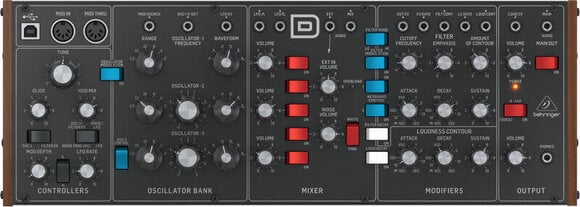
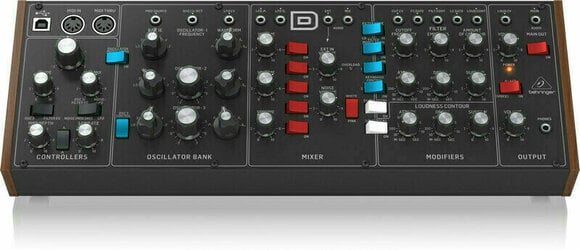
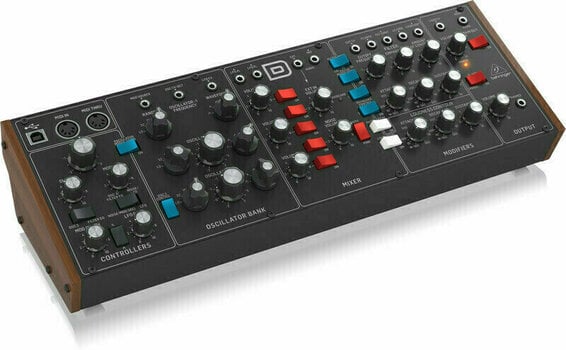
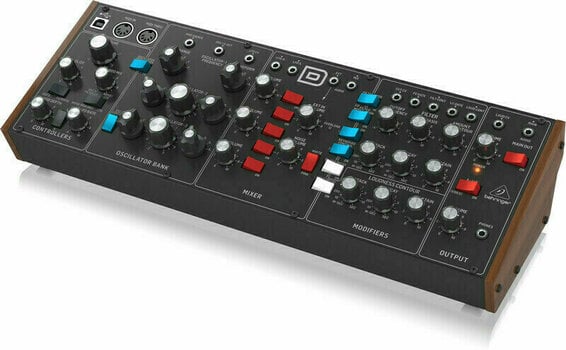
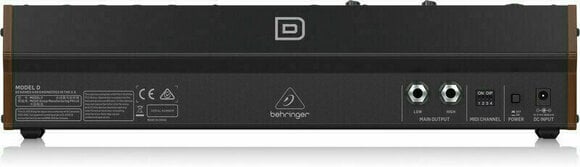

Behringer Model D Synthesizer
The Behringer Model D is an authentic analog monophonic synthesizer that recreates the legendary Minimoog Model D at a fraction of the original's cost. Three voltage-controlled oscillators feed a 24 dB ladder filter with selectable low- and high-pass modes, while a semi-modular patch bay and Eurorack-ready chassis make it equally at home on a desktop or in a modular rig.
- Three analog VCOs with six waveforms each and a six-octave range give the Model D its unmistakable fat, punchy character.
- The 24 dB ladder filter self-oscillates and offers both low-pass and high-pass modes, expanding the classic Moog voicing with extra timbral options.
- Semi-modular design with 3.5 mm patch jacks means it works straight out of the box yet interfaces cleanly with any Eurorack system.
- Chain up to 16 units for polyphonic performance, and connect via USB MIDI or traditional DIN for full studio integration.
Behringer Model D Analog Synthesizer — Classic Moog Voice, Modern Price
The Behringer Model D is an authentic analog monophonic synthesizer designed as an ultra-affordable homage to the iconic 1970s Minimoog Model D. Its pure analog signal path is built around three voltage-controlled oscillators, a 24 dB ladder filter, a dedicated VCA, and a fully analog triangle/square wave LFO. The Model D is the right choice for producers, sound designers, and performing keyboardists who want the unmistakable fat bass and lead tones of a vintage Moog without paying vintage prices.
What Sets the Model D Apart in the Analog Synth Category
Few modern analog synths at this price point offer a true Eurorack-compatible chassis, and the Model D ships in a 70HP "boat" case that drops straight into a standard rack. The 24 dB ladder filter is dual-mode, providing both the expected low-pass response and a high-pass mode that the original Minimoog never had, opening up new timbral territory. A built-in feedback loop routes the main output back into the external audio input when nothing is patched in, letting players dial in everything from subtle thickening to aggressive saturation without extra cables.
Oscillator Architecture — The Heart of the Sound
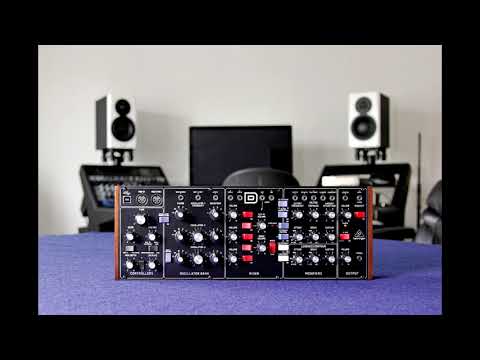
The three-oscillator architecture is what gives the Model D its famously thick, punchy character. Oscillators 1 and 2 each offer six waveforms (triangle, triangle/saw, saw, square, wide pulse, narrow pulse), while OSC 3 swaps the triangle/saw for a reverse saw, making it equally useful as an audio source or as a sub-audio modulation source.
- Oscillators: 3 analog VCOs — the foundation of the classic Moog stack sound
- Waveforms per OSC: 6 selectable shapes — broad timbral range from soft triangles to aggressive pulse waves
- Octave Range: LO, 32', 16', 8', 4', 2' — six octaves of coverage from sub-bass to high leads
- Detune Range: approx. ±7 semitones (OSC 2 and OSC 3) — for everything from gentle chorus to dissonant intervals
Filter, Envelopes, and Modulation — Shaping Every Note
The 24 dB ladder filter is the soul of the instrument, capable of self-oscillation down to 64 Hz and offering switchable low-pass and high-pass modes. Independent ADS(D) envelope generators shape both the filter cutoff and the VCA, with the loudness contour offering a maximum attack of around 11 seconds and a release of roughly 22 seconds. Five modulation sources — OSC 3, filter envelope, noise, external input, and the dedicated LFO — can be mixed and routed to either oscillator pitch or filter cutoff.
- Filter: 24 dB/oct ladder, switchable LP/HP — self-oscillating resonance with classic Moog character
- Envelopes: 2× ADS(D) (filter + loudness) — independent gate inputs for advanced patching
- LFO: 1 analog triangle/square wave — switchable rate, depth, and modulation routing
- Noise Generator: switchable pink/white — adds air, grit, or percussion-style sounds
Connectivity, Build, and Poly Chain — Studio and Stage Ready
The Model D weighs less than 2 kg and packs 29 knobs and 19 switches into a compact 374 × 136 mm panel. MIDI I/O and Thru are available over both USB and traditional DIN, and a dedicated headphone output with its own volume control sits on the front panel. The semi-modular patch bay exposes 3.5 mm jacks for pitch CV, LFO frequency, filter cutoff, amplifier gain, envelope gates, and external modulation, while the Poly Chain function links up to 16 units for full polyphonic performance.
- Poly Chain: up to 16 voices — combine multiple units for true polyphony
- MIDI: USB + DIN In/Out/Thru — works with any modern DAW or hardware controller
- Patch Bay: 3.5 mm semi-modular jacks — interfaces with Eurorack and external CV gear
- Headphone Output: yes, with dedicated volume — silent practice without an audio interface
- Power: external 12V DC — keeps the analog circuitry isolated from digital noise
Who the Behringer Model D Is For
The Behringer Model D is the right choice for electronic musicians, hip-hop and synthwave producers, and live performers who need authoritative analog bass and lead tones at a price that fits any project studio. Sound designers will appreciate the semi-modular patch bay and Eurorack compatibility for integrating the synth into a larger modular system. Beginners stepping into analog synthesis for the first time will find the intuitively linear workflow approachable, with no patching required for immediate play. Players who already own a Minimoog Model D or a Moog reissue can use the Model D as a portable, road-ready backup that captures the same sonic DNA.
Behringer and the Model D Story
Behringer was founded by Uli Behringer, who grew up in a musical family in Baden, Switzerland and built his first synthesizer at the age of 17. The Model D pays tribute to the Minimoog Model D that defined progressive rock, wave, and synth-pop in the 1970s and '80s, an instrument championed by Jan Hammer, Chick Corea, Rick Wakeman, Jean-Michel Jarre, Isao Tomita, and Keith Emerson. By recreating that legendary architecture with matched transistors, JFETs, and 0.1% thin-film resistors, Behringer has made one of synthesis history's most coveted voices accessible to a new generation of players.

Type
Desktop Synthesizer, Semi-modular
Aftertouch
LFO
Kuvert
Ja
Oscillatorer
Modulation
Arpeggiator
Effekttyper
MIDI-grænseflade
Bluetooth
Hovedtelefon udgang
Udgange
Pedal indgange
USB MIDI
USB til vært
Filter
Low Pass, High Pass
Sekvenser
Nej
Strømforsyning
Adapter
UK/EU Strømforsyning er inkluderet
Bredde (cm)
37,4
Højde (cm)
9
Dybde (cm)
13,6
Nettovægt (kg)
1,7
Lavet i
Kina


Alle anmeldelser kommer fra verificerede kunder, der tidligere har købt et produkt hos os.
AI-opsummering af anmeldelser
Baseret på antallet af anmeldelser: 24
Styrker
- Lydkvalitet: Kunderne fremhæver konsekvent den fremragende lyd, især den kraftfulde bas, og bemærker, hvor godt den passer i et mix.
- Valuta for pengene: Mange brugere er imponerede over den kvalitet, der tilbydes til prisen, og anser den for at være en fremragende investering.
- Brugervenlighed: Synthesizeren er værdsat for sine praktiske betjeningselementer, som eliminerer behovet for at dykke ned i menuerne og giver en retro-følelse.
- Kompakt design: Dens lille størrelse er en betydelig fordel, hvilket gør den til en pladsbesparende mulighed for brugerne.
Svagheder
- Læringskurve for begyndere: Nogle nye brugere kan finde den indledende læringsproces udfordrende, selvom det bliver sjovt med øvelse.
Hvad kunderne gentager
Konklusion
Dokumenter
Brugsanvisninger
Producentinformation
Sikkerhedsinstruktioner
Se brugervejledningen for de specifikke sikkerhedsinstruktioner for dette produkt.


